No fluff. No fads. Deep-dive investigative reports from the surgeon who actually sees the inside of the joints.
Every time you stand up, climb a stair, or decelerate from a jog, four quadriceps muscles pull on a rope of tissue that travels over your kneecap and attaches to the shin. That rope has two segments — the quadriceps tendon (above the patella) and the patellar tendon (below it). Either one can snap.
When one snaps, the kneecap loses its anchor. You cannot straighten the knee against gravity. Most patients describe the same sensation: a loud pop, a feeling that something "gave," and then the leg simply refuses to extend.
Patellar tendon ruptures happen most often in active people in their 30s and 40s — basketball players landing awkwardly, weekend warriors coming down from a jump. The tendon most commonly fails at its attachment to the inferior pole of the patella.
On exam, the kneecap sits higher than it should (patella alta). There is a palpable gap below the kneecap. The patient cannot perform a straight-leg raise.
Quad tendon ruptures skew older — typically patients over 40, often with a history of chronic tendinopathy, fluoroquinolone antibiotic use, corticosteroid injections, or systemic illness like diabetes or renal disease. The tendon fails just above the patella.
The gap sits above the kneecap instead of below it. The patella may ride lower than normal (patella baja).
Physical exam catches most of these injuries. The inability to do a straight-leg raise with a palpable defect is nearly pathognomonic. X-rays confirm the patella's position. An MRI is ordered when the exam is equivocal or when you need to assess tear completeness and retraction before surgical planning.
"The single biggest determinant of outcome is time from injury to repair. Under 2 weeks, the tendon ends still know where they came from. After 6 weeks, the muscle has retracted, scarred, and lost elasticity — now you're reconstructing rather than repairing."
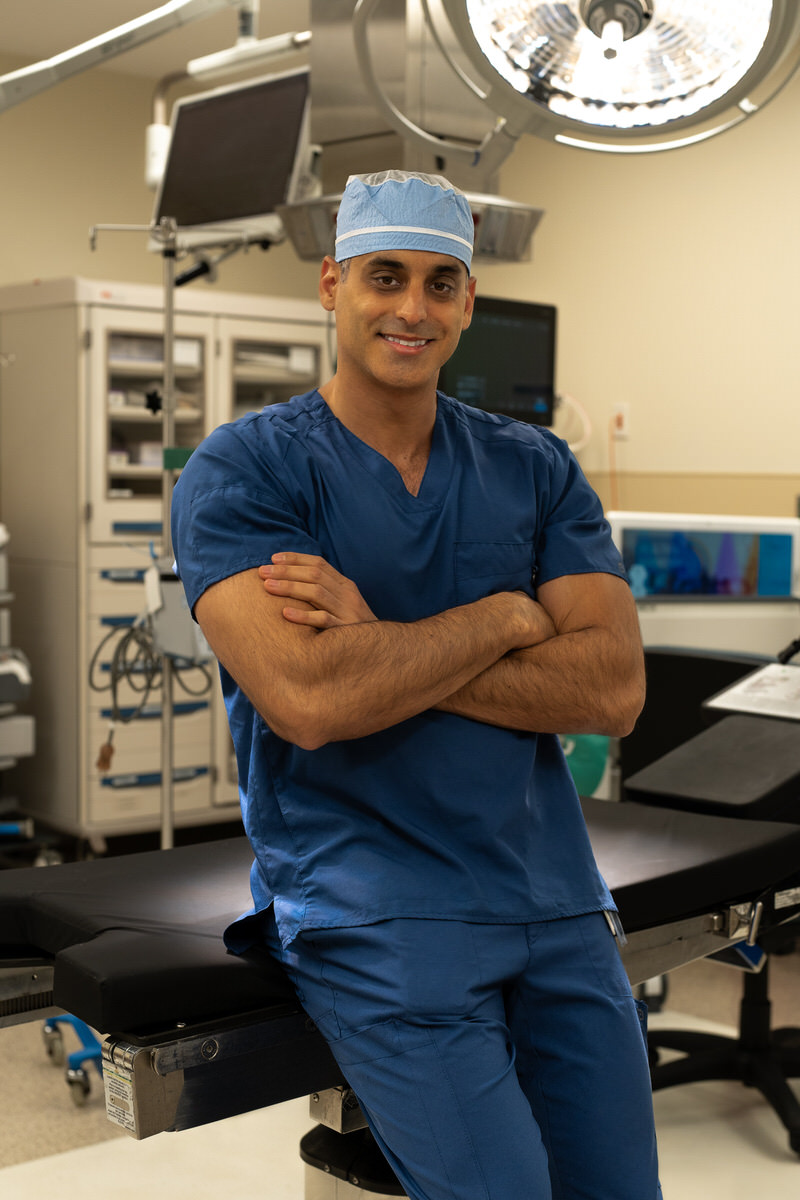
— Dr. Sameh Elguizaoui, Sports Medicine
A complete rupture is a surgical injury. Non-operative management leaves you unable to reliably extend the knee, which ends athletic careers and makes simple tasks (stairs, getting up from a chair) a chronic struggle.
A midline incision exposes the kneecap and the tear. Hematoma is debrided; tendon ends are identified and refreshed.
Heavy non-absorbable suture is woven through the tendon in a Krackow or whip-stitch pattern to grip tissue without cutting through it.
Sutures are passed through drill holes in the patella (or secured with suture anchors) and tied over a bone bridge to re-establish the tendon's footprint.
The repair is tested through a range of motion to confirm the kneecap sits at the correct height and the repair holds at 90° of flexion.
Brace locked in extension. Weight-bearing as tolerated with crutches. Quad sets and ankle pumps begin day 1.
Brace unlocks 0–30°, progressing 30° every 2 weeks. Scar mobilization. Patellar mobilization.
Full ROM, brace discontinued, closed-chain strengthening, stationary cycling.
Running progression, plyometrics, sport-specific drills.
Return-to-sport testing. Full clearance for cutting/pivoting sports typically 6–9 months.
return to recreational activity after acute repair
ideal surgical window from injury
to full return to cutting sports
If your knee pops, buckles, and you cannot lift the leg straight — get to an orthopedic surgeon within 10 days. Acute tendon repair is one of the highest-yield operations we do. Delayed repair is a different, harder operation with a longer, less predictable recovery.
Same-week evaluation for acute knee injuries across our Manhattan, Brooklyn, and Scarsdale offices.
Book an Urgent Consult →Partial tears with intact extensor function (able to straight-leg raise) can be braced in extension for 6 weeks with a high rate of healing. Complete tears require repair.
Only if repair is delayed beyond roughly 6 weeks and the tendon has retracted significantly. Acute repairs almost never need augmentation.
Right leg: typically 6–8 weeks once off narcotics and out of the brace. Left leg with automatic transmission: 1–2 weeks.
Re-rupture is uncommon (under 2%) if the repair is done acutely and rehab is followed. The biggest risk factor is returning to cutting sports before month 6.
Get Started
Take the first step toward recovery. Schedule a consultation with Dr. Elguizaoui to discuss your condition and explore your treatment options.